





Book Reviews
"This is a highly original and extremely rich study of the artistic process as one of creative processing, or working through. Valuably based on interviews with other artists as well as on Townsend’s self-reflection on her own artwork, this book compellingly argues that artistic forms grow out of our inner worlds but are not simply a representation of these. This study is the most resonant and detailed psychoanalytic account of creative processes that I have read since the work of Marion Milner. Like Milner’s contributions to our understanding of art, it should be an essential read for artists as well as for those who study them, or seek to understand artworks."
Catherine Grant, Professor of Digital Media and Screen Studies, Birkbeck, University of London
"Psychoanalysis has struggled to understand the process of artistic creativity from the inside, but Patricia Townsend’s outstanding book draws on interviews with professional artists as well as her own experience to investigate the process, from the artist’s first awareness of a creative work through to its emergence into the world. Taking cues from Donald Winnicott, Marion Milner and Christopher Bollas in particular she builds a convincing and subtle account of the unfolding creative act, which will engage anyone interested in how it is that we relate creatively to our worlds."
Ken Robinson, Psychoanalyst, Visiting Professor of Psychoanalysis, Northumbria University
"It is full of insight and makes the essential point "that the artwork both provides a form for a previously unformed inner experience and presents some aspect of the outside world in a new way".
Piers Plowright, The Tablet, 20th April 2019
"A key underlying question posed by Townsend’s book is: can psychoanalysis throw light on art without reducing it? It is an original contribution to questions such as this, filling a gap in theorising about art and doing so with conscientious attention to detail and respect for the interviewees and their individual process and achievement. Townsend has the advantage of being both clinician and artist, and her use of her own work is both generous and illuminating. She offers us a compelling account of the artistic process, employing interviews with 33 artists, from the point of view of the Independent Tradition where an interest in creativity is a hallmark."
Emma Letley, British Journal of Psychotherapy, November 2019
"This book offers a window on enhancing understanding not only of ourselves as artists, but our clients, too." Helen Jury, Newsbriefing (The British Association of Art Therapists newsletter) Summer 2019
"Ultimately, wherever one stands with respect to the suggested theoretical framework or psychoanalysis more generally, this book provides valuable insight into the process of art-making, especially as regards its core experiential features. As such, it is a fine contribution to creativity research and should be of great interest to both artists and academics."
Jussi A. Saarinen, Creativity Research Journal, Spring 2020
“In one of the most resonant passages of the book Townsend proposes that our sense of ourselves as living subjects is reliant upon an essentially creative relationship with the external world whereby ‘we do not [. . .] respond to elements of the outside world as if they are fixed in meaning and essentially dead’ but instead ‘[imbue] it with our own inner experience’ (p. 116). Whether in producing a garden, making changes to a favourite recipe, or offering an interpretation of a favourite book, Townsend argues, ‘we are always in the process of self-realisation, a process of destruction and creation that is never completed. To continue this process, we must continue to ‘live creatively”’.
Lucy Arnold, The Year’s Work in Cultural and Critical Theory, Section 4. Creative Subjects: Psychoanalysis and Visual Art, Oxford University Press, April 2020.
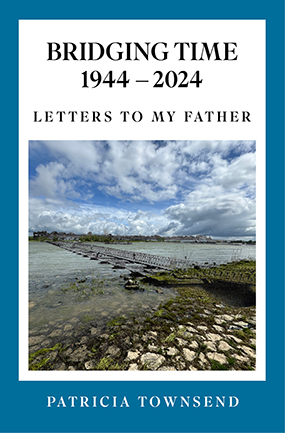
Bridging Time 1944 - 2024
Letters to my Father
My father, Sam Townsend, served with the Royal Engineers during the closing months of World War 2, writing letters home to his parents every few days. After the war he never spoke of his experiences and I didn’t know his letters existed until, shortly before his death, he gave them to me. Although he couldn’t disclose where he was when he wrote each letter, I was amazed by his vivid descriptions of what he saw and felt.
In this book, I reply, 80 years later, to my father’s letters. My letters to him are in the form of sonnets, each responding to, and quoting from, a particular letter from him to my grandparents. The book is richly illustrated with photographs, many taken on a journey I made in 2024, following my father’s war route through France, Belgium, the Netherlands and Germany. Some of these are montaged with wartime photographs. Others are from my father’s own album.
The book is my attempt to understand my father’s experiences, how they affected him
and how they may have indirectly impacted my own childhood.
Book Reviews
London Grip Poetry review – BRIDGING TIME 1944-2024: Thomas Ovans is both intrigued and moved by Patricia Townsend’s sonnet sequence incorporating and responding to wartime letters from her father.
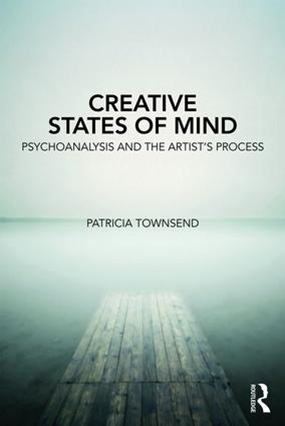
Creative States of Mind
Psychoanalysis and the Artist’s Process
What is it like to be an artist? Drawing on interviews with professional artists, this book takes the reader inside the creative process. The author, an artist and a psychotherapist, uses psychoanalytic theory to shed light on fundamental questions such as the origin of new ideas and the artist’s state of mind while working.
Based on interviews with 33 professional artists, who reflect on their experiences of creating new works of art, as well as her own artistic practice, Patricia Townsend traces the trajectory of the creative process from the artist’s first inkling or ‘pre-sense’, through to the completion of a work, and its release to the public. Drawing on psychoanalytic theory, particularly the work of Donald Winnicott, Marion Milner and Christopher Bollas, the book presents the artist’s process as a series of interconnected and overlapping stages, in which there is a movement between the artist’s inner world, the outer world of shared ‘reality’, and the spaces in-between.
Creative States of Mind: Psychoanalysis and the Artist’s Process fills an important gap in the psychoanalytic theory of art by offering an account of the full trajectory of the artist’s process based on the evidence of artists themselves. It will be useful to artists who want to understand more about their own processes, to psychoanalysts and psychotherapists in their clinical work, and to anyone who studies the creative process.